

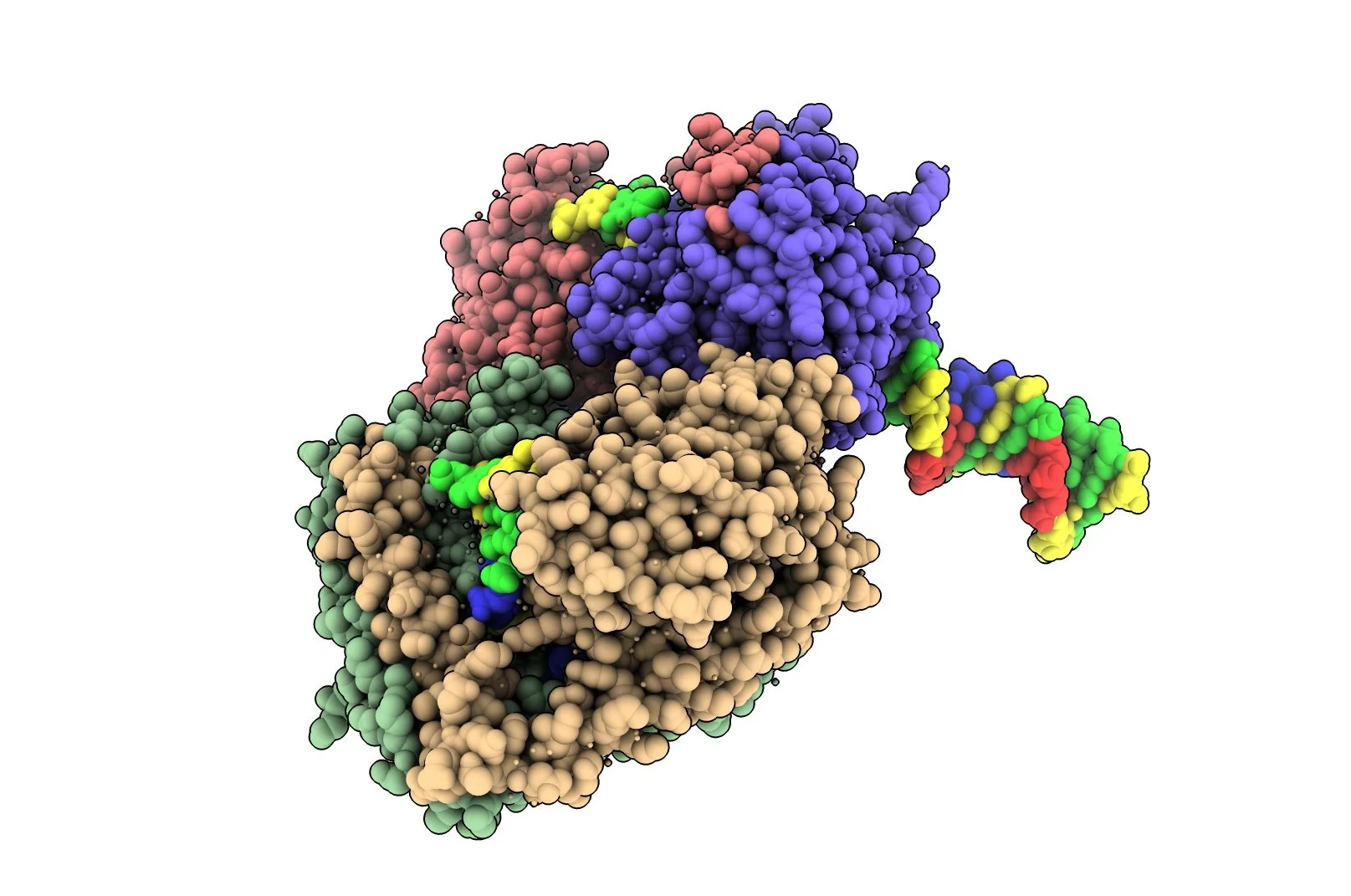
Image of HindIII homodimer interacting with DNA was derived from Protein Data Bank (PDB) and rendered by UCSF ChimeraX
Introduction
Protein Expression and Purification connects students’ DNA constructs to tangible, measurable biological products. By turning cloned genes into purified proteins, students experience how molecular designs become functional molecules that can be studied, engineered, and applied across biotechnology, medicine, and research.
How Protein Expression and Purification fits into the larger scope
This module follows DNA cloning and transformation, using engineered host cells to produce the proteins encoded by student-generated constructs. Students learn how experimental choices - such as induction conditions, lysis methods, and purification strategies - influence protein yield and quality. This stage reinforces the full arc of the project, from sequence design to functional protein
IPTG induction
In this submodule, students regulate protein production by adding IPTG to cultures carrying inducible expression plasmids. They learn how inducer concentration, timing, and growth conditions affect the amount and solubility of the target protein. This activity highlights core concepts in gene regulation and shows how controlled expression systems are used throughout modern biotechnology.
Protein Extraction
The Protein Extraction submodule focuses on releasing proteins from host cells after induction. Students use mechanical and/or chemical lysis methods to break open cells and generate clarified lysates containing their protein of interest. Along the way, they explore how buffer composition, temperature, and handling conditions help preserve protein structure and activity.
Protein Purification/Isolation
In this submodule, students isolate their target protein from a complex mixture of cellular components. Using accessible affinity-based methods, they learn how specific biochemical properties - such as tag identity, charge, or binding interactions - enable separation of one protein from many. This experience underscores how purification strategies are designed around protein features and why purity is essential for downstream applications like activity assays, structural studies, or diagnostic use.